DALE CARNEGIE
How to Win Friends and Influence People
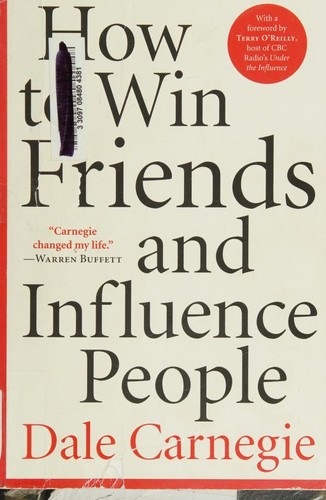
- Author
- Dale Carnegie
- Category
- Self-DevelopmentSelf-HelpCommunicationPsychology
- # of Pages
- 291
- Published
- October 1936
- Publisher
- Simon & Schuster
- Status
- Currently reading
One-paragraph review
Coming soon.
Three-paragraph summary
Coming soon.
Full summary & key takeaways
- We are only half awake. We live life so far from our limits.
- We learn by doing — as Bernard Shaw put it, if you merely tell a man something, he never really learns it.
- Offer up a small financial loss for every time you break one of this book’s rules.
- Keep track of your communication with people all week — every meeting and interaction. At the end of the week, reflect: What mistakes did I make? What did I do right? What could I have improved? What did I learn?
- People are stubborn, and it’s foolish to scold. Nine times out of ten, no one criticizes themselves for anything, no matter how wrong. Criticism is dangerous — it wounds pride, hurts a person’s sense of importance, and arouses resentment.
- Rewarding good behaviour works far better than punishing bad. As much as we thirst for approval, we dread condemnation.
- The resentment that criticism breeds demoralizes people without correcting the situation.
- Criticisms are like homing pigeons — they always return home. The person we criticize will criticize us back.
- Don’t judge others as if you’re better. Look at your own mistakes and realize you’re just as worthy of judgment — and might be the same or worse under similar circumstances.
- Stop trying to improve others; focus on improving yourself. Confucius: “Don’t complain about snow on your neighbour’s roof when your own doorstep is unclean.”
- A round of stinging back-and-forth criticism can create everlasting hurt.
- Benjamin Franklin: “I will speak ill of no man, and speak all the good I know of everybody.”
- Any fool can criticize, condemn, and complain — it takes character and self-control to be understanding and forgiving.
- “A great man shows his greatness by the way he treats little men.” — Carlyle
- Bob Hoover, after a mechanic fuelled his plane wrong and nearly killed him, said: “To show you I’m sure you’ll never do this again, I want you to service my F-51 tomorrow.”
- God himself does not propose to judge a man until the end of his days — so who are you to judge others?
- There’s only one way to get anybody to do anything: make them want to do it. The only way to influence someone is to talk about what they want and show them how to get it.
- Freud thought everything we do springs from two motives: the sex urge and the desire to be great. Dewey said the deepest urge in human nature is the desire to be important.
- Most of our desires get satisfied — except the desire to feel important.
- Everybody likes a compliment. Make it as genuine as possible.
- William James: “The deepest principle in human nature is the craving to be appreciated.”
- You can tell what a person is by how they get their feeling of importance. It determines their character.
- People may go insane to find, in the dreamland of insanity, the feeling of importance denied them in reality. Many who go insane have nothing organically wrong — they find in it an importance they couldn’t achieve in the real world.
- Imagine the miracles you could work by giving people appreciation on this side of insanity.
- Charles Schwab: “The way to develop the best in a person is by appreciation and encouragement. I am anxious to praise but loath to find fault. I am hearty in my approbation and lavish in my praise.”
- “Once I did bad and that I heard ever / Twice I did good, but that I heard never.”
- Learn to gather and lead people smarter than you. It doesn’t matter who takes credit — what matters is the work gets done well.
- The number-one reason for divorce is a lack of appreciation.
- We need to nourish our self-esteem the way we nourish our bodies with food.
- Flattery does more harm than good in the long run. It’s counterfeit, and like counterfeit money it eventually gets you in trouble. Appreciation is sincere; flattery is not.
- “Teach me neither to proffer nor receive cheap praise.” Flattery is telling people what they want to hear about themselves.
- All our associates are human beings hungry for appreciation.
- I shall pass this way but once. Any good or kindness I can show to any human being, let me do it now — I shall not pass this way again.
- Emerson: “Every man I meet is my superior in some way. In that, I learn of him.”
- Forget flattery — give honest, sincere appreciation.
- Bait the hook to suit the fish. Don’t think about what you want; think about what the other person wants and cater to that.
- You are eternally interested in what you want — but no one else is. The only way to influence people is to talk about what they want.
- When you donate, you want the feeling of being good more than the money.
- Action springs from what we fundamentally desire. To influence people, arouse in them an eager want.
- Before asking anyone to do something, pause and ask: How can I make this person want to do it?
- When you argue, remember the other person’s pride. Even if you win, their bruised pride means they won’t feel good doing what you ask.
- Henry Ford: “If there is any one secret of success, it lies in the ability to get the other person’s point of view and see things from their angle as well as your own.”
- As a salesperson, show customers how your product solves their problem and they’ll buy it — people love feeling like they’re buying, not being sold to.
The principles so far
Principle 1: Don’t criticize, condemn, or complain. Principle 2: Give honest and sincere appreciation.
Most things people want
- Health and the preservation of life
- Food
- Sleep
- Money and the things money will buy
- Life in the hereafter
- Sexual gratification
- The well-being of our children
- A feeling of importance
My notes to self
- One of my biggest realizations: I’ll likely never see most of the people I meet again — or wouldn’t even remember if I did. Treat each interaction as its own complete thing.
- Think of how the Prophet Muhammad made everyone leave his presence with their pride intact — in fact, with more pride than before.
- How to work with this book: skim the chapters, then read each one thoroughly, again and again. Visualize using the concepts. Review them once a month. Popularity, influence, and healthier relationships depend on it.
- Nightly, write down everything that happened that day — every interaction. Ask: What mistakes did I make? What did I do right, and how could I have improved? What did I learn? When something impressive happened, note it and praise the person for it.